
As Paulig celebrates 150 years of shaping food culture, we continue exploring not just great taste but responsibility and transparency. Our collaboration on large-scale ingredient-level sustainability assessments with HowGood, with the world’s largest food sustainability database, marks a new chapter in our sustainability journey.
To further strengthen transparency and lead the responsible way of working, Paulig is now publishing information on a broad set of sustainability metrics for key Tex Mex products. By opening up ingredient impact across key environmental and social indicators on the farm level, Paulig aims to inform and inspire consumers, customers and partners, with an increased understanding of how the food we eat influence the sustainability footprint. This marks a concrete step in making sustainability information more accessible and transparent, and demonstrating how large-scale data can support the sustainability work and our road toward planet healthier products.
One of Paulig’s sustainability ambitions is that 70 % of total sales shall come from products enabling health for people and planet by 2030. We have already established a framework for people health, based on the front-of-pack nutrition label Nutri-Score, and set course systematically toward the goal. In the process of defining ‘products enabling health for the planet’, Paulig is using HowGood’s science-based and broad approach to assess sustainability impact and create a roadmap toward better-performing products. During the process and throughout the long-term collaboration, Paulig wants to be transparent in how we work with sustainability on the product level, showcasing initial results for key products.
Using HowGood’s streamlined methodology, we have assessed over 2,500 of Paulig’s products, covering ~90 %* of our sales from foods and drinks across eight sustainability metrics, from greenhouse gas emissions and water usage to biodiversity and labour risk. The assessment is focusing on (but not limited to) farm-level impact of each ingredient, based on share of ingredients and their country of origins. Where data have been missing, it has been estimated by HowGood** using their extensive sustainability food data base. For the majority of ingredients, the on-farm impact far surpasses that of other carbon lifecycle stages. Having highly-granular data on this stage helps to ensure our improvement strategy is based on the area where we can have the biggest impact.
To extend our work of the sustainability assessment that we do as a step toward our 2030 goal, we want to already now transparently share and display the performance of Paulig core products – products composing the beloved Tex Mex meal.
*Covers 93% of the sales from food and drink products year 2024, the baseline for data collection.
** HowGood is working on facilitating the calculation and display of share of provided and estimated product data, which we aim to disclose. Note! We will continuously improve our data in terms of internal accuracy, share of information and level of details provided to HowGood, and results from ongoing sustainability work.Hence, metric impacts and HowGood Impact Scores will be updated gradually.
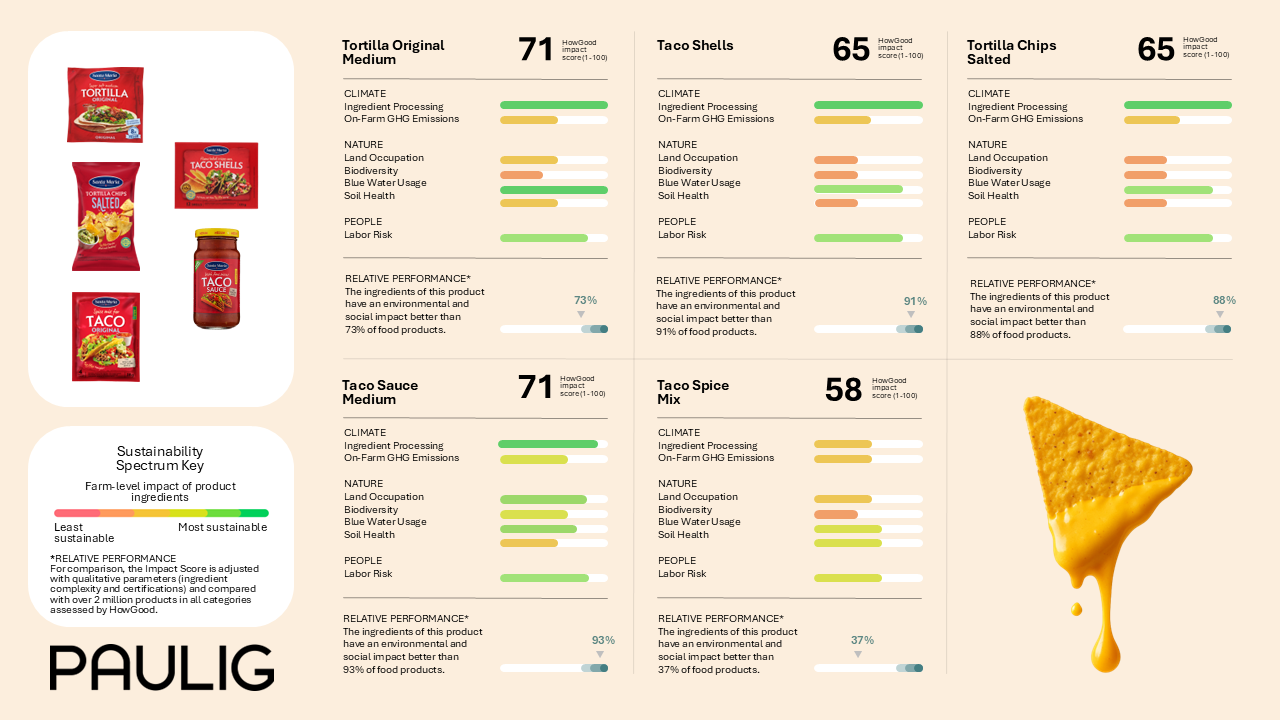
Impact assessment of eight sustainability metrics performed by the independent research company HowGood. The impact of the metrics are summarized into a HowGood Impact Score. The impact of each metric, the HowGood Impact Score, and the relative performance will be continuously updated as data accuracy and sustainability efforts progress.
The result? An externally assessed snapshot of our top-selling product ingredients’ on-farm impact of eight sustainability metrics - where we are, where we do well, and where we can do better. These insights provide transparency in our ongoing work towards offering “products enabling health for the planet.” For packaging, which is excluded from the assessment, Paulig has set separate targets, which is the case also for greenhouse gas emissions of our own operations and value chain, and sourcing from risk countries.
What is HowGood and what do they measure?
HowGood is an independent research company and sustainability platform, backed by many years of scientific research on global food supply chains. The team consolidates and analyzes findings from over 600 accredited data sources, standards, and international frameworks. HowGood assesses the social and environmental impact of more than 33,000 ingredients across eight sustainability metrics. Their impact assessment, includes eight core metrics on the ingredient and on-farm level (for energy requirement also factory ingredient processing level).
- Greenhouse Gas Emissions: What is the carbon footprint of the ingredients in this product? (Farm-to-farm gate: all on-farm processes, off-farm cleaning and sorting, and primary inputs like fertilizer, pesticides, herbicides, and farm machinery fuel.)
- Processing: How much energy is used to process the ingredients in this product? (Factory processing; example of wheat flour: energy requirements for processes like washing, grinding, sorting, and sifting).
- Water Usage: How much water does it take to grow the ingredients in this product?
- Biodiversity: Does the growing of the ingredients in this product help or harm biodiversity? (The impact that a given ingredient's production, including growing, extracting, or land use, has on its surrounding ecosystem. This includes the impact on both animals and trees, and microflora, such as bacteria, fungi, etc.)
- Soil Health: How does the growing of the ingredients in this product impact the soil?
- Land Occupation: How much land is required to produce the ingredients in this product?
- Animal Welfare: If relevant, how are the animals involved in the production of an animal-derived ingredient treated?
- Labor Risk: What is the overall labor risk involved in the ingredients in this product, considering both the severity of the working conditions and the number of people affected?
HowGood Impact Score
Based on HowGood ’s assessment of eight individual, quantitative sustainability metrics, a summary score is created: ‘HowGood Impact Score’. Based on the picture provided, we can navigate among our products to find hot spots, for which HowGood’s database enables and facilitates iterative ways of working towards improvement.
For rating purposes and comparison of impact between products, the HowGood Impact Score is further processed with qualitative parameters and adjusted considering the following additional factors:
- Processing: whether a product contains ingredients that are heavily processed. (Accounts for environmental costs associated with more intensive, multi-stage processing, beyond the average impact of standard techinques applied to the processing core metric).
- # of ingredients: the number of ingredients in a product; three or fewer impacts beneficially, 13 or more impacts negatively. (Accounts for the cumulative environmental impact of a product’s complexity and each new supply chain introduced by each new ingredient, respectively).
- Labor conditions: labor issues associated with sourcing locations and whether a product has a FairTrade certification.
- Organic: whether a product has an organic certification.
(The certifications represent a higher standard for the product as a whole that goes beyond the individual standards of its component ingredient supply chains.)
The adjusted HowGood Impact Score is compared with all products, regardless of category, that are evaluated in HowGood's food data base - the largest food sustainability data base in the world with over 2 milllion products.